

Imagine a new employee joining your organisation tomorrow. On their first day, would you give them unrestricted access to your CRM, finance platform, payment systems and customer data, then simply trust them to work out what they should and shouldn’t be doing?
Probably not. You would decide which systems they genuinely needed access to, apply the appropriate permissions and make sure there was some level of visibility over what they were doing, particularly where sensitive data or business-critical processes were involved.
So why would we treat an AI agent differently?
As organisations explore the potential of AI agents, the conversation is quickly moving beyond using AI to generate content or support employees. Increasingly, agents are being considered as part of operational business processes, with the ability to access systems, interpret information, make decisions and take action.
That creates significant opportunities for automation, but it also introduces a different type of risk.
Traditional business processes are generally built using code designed to carry out a defined set of actions. Once that code has been tested, approved and deployed, its behaviour should remain relatively predictable unless somebody makes a change. An AI agent is different because it can interpret context and make decisions dynamically, meaning its behaviour may not always be as easy to predict in advance.
That doesn’t mean organisations should avoid using AI agents. It does, however, mean they need to think carefully about the environment those agents are operating within and, crucially, how much freedom they are given.
Don’t give an AI agent the master key
If an agent needs to interact with your CRM, there should be a defined and controlled way for it to do so. If it needs information from a finance platform, it should only be able to access the information required for that particular process, and if it has no reason to modify or delete information, it should not have the permissions required to do so.
The principle is fairly straightforward: rather than relying solely on instructions telling an AI agent what it should and should not do, the architecture around it should place practical limits on what it is actually capable of doing.
That is where established integration principles become particularly important.
Authentication, authorisation, separation of concerns, controlled interfaces and monitoring are not new concepts, and AI does not suddenly make them obsolete. In many respects, the arrival of autonomous or semi-autonomous agents makes these principles more important because organisations are introducing something capable of making decisions dynamically into environments containing valuable data and critical business processes.
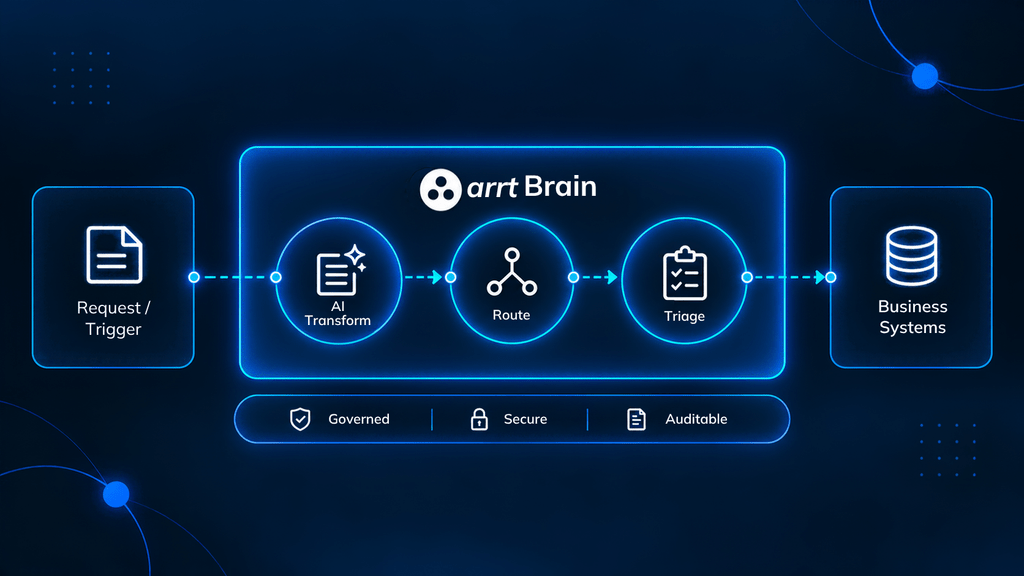
Rather than allowing agents to create individual connections into CRM platforms, finance systems, payment services and other applications, a structured integration architecture can provide defined routes through which those interactions take place.
This allows an organisation to determine which systems an agent can reach, what information it can access, what actions it is authorised to perform and how those interactions are monitored.
In other words, you do not necessarily need to make the AI itself completely predictable. You create a controlled environment around it.
Looking beyond traditional security
There is another part of this conversation that we think is particularly important.
Protecting an organisation from unintended AI behaviour is not simply about traditional cyber security or detecting somebody attempting to gain unauthorised access from outside the organisation. As agents become involved in business processes, organisations also need to understand whether what is happening inside their systems makes sense from a business perspective.
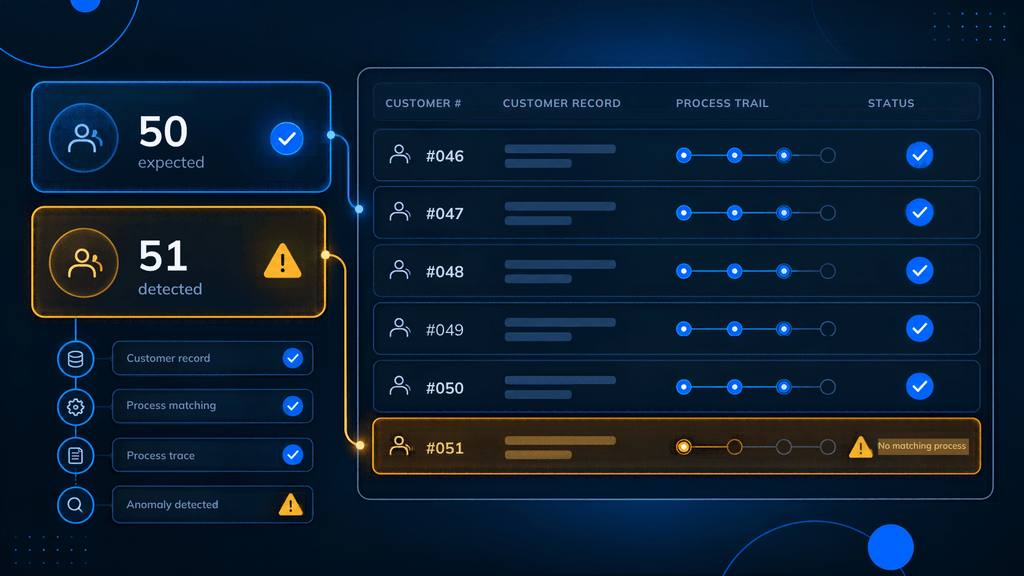
Imagine, for example, that an approved customer onboarding process results in 50 new customer records being created. If those interactions take place through a structured integration architecture, there is a clear relationship between the processes that have run and the data that has appeared within the downstream systems.
Now imagine a 51st customer suddenly appears, but there is no corresponding process that should have created it.
Likewise, if a payment is initiated but there is no recognised business process behind that transaction, it becomes something that needs to be understood.
Neither scenario automatically means something malicious has happened, but having a structured architecture makes unexpected activity easier to identify and investigate because there is much greater visibility of how your systems are supposed to interact.
Without that structure, organisations can gradually accumulate applications, integrations, scripts and AI agents that all have their own routes into core systems. The more fragmented that environment becomes, the harder it is to understand what has happened, where an interaction originated and whether it should have happened at all.
Where the ARRT Brain fits
This is where the architecture behind the ARRT Brain becomes particularly relevant.
The Brain provides a structured integration layer between business processes and the systems they need to interact with, rather than relying on a growing collection of point-to-point connections between individual applications.
That architecture creates a foundation through which access can be controlled, authentication and authorisation can be applied, interactions can be monitored and individual processes can be restricted to the systems and data they genuinely require.
As organisations introduce AI agents into those processes, the same architectural principles can provide the guardrails around them.
The objective is not for the ARRT Brain to somehow make an AI agent completely predictable. It is to create a controlled environment in which the organisation retains authority over what that agent can reach and what it can do once it gets there.
That distinction is important, because the underlying rules of good integration have not changed simply because AI has arrived.
If you would not give every employee unrestricted access to every system in your organisation, there is no reason to give that level of access to an AI agent. Likewise, if you would not allow a new application to connect directly to sensitive systems without appropriate authentication, governance and monitoring, an AI agent should not be treated as an exception.

AI can sit inside the guardrails too
There is another direction that we think will become increasingly important as the technology develops.
So far, we have talked about AI agents interacting with business systems through a controlled integration layer. But AI could also become a component within that integration layer itself, carrying out specific, tightly defined tasks as part of a wider business process.
This is where some of the newer technologies we are looking at become interesting. Jev.ai, for example, works with structured inputs and outputs rather than relying on a free-form conversation. In an integration context, that opens up the possibility of asking AI to perform a very specific function and return something the wider process can work with.
For example, it could potentially help analyse two different data structures and support the mapping required for a transformation. It could assess an error and help determine where it should be routed, or evaluate a number of possible outcomes and return a confidence score.
That score is where the surrounding architecture still matters. The process can decide what threshold needs to be met before an action is allowed to continue, or when a result should be sent for further review.
The important distinction is that the AI does not own the process. It is being given a defined role within it, while the architecture still determines what information it receives, what it is allowed to return and what happens next.
That is the area we are exploring with the ARRT Brain. Jev.ai is one example of the kind of technology that could support functions such as transformation, routing and triage, while the Brain continues to provide the structure, governance and visibility around the wider process. It is still early, and there is testing and validation to do, but the direction is interesting: AI does not necessarily need to replace the rules and structure around a business process. It can operate within them.
AI agents may represent a new way of automating business processes, but the principles behind adopting them safely are remarkably familiar. Give AI enough access and autonomy to create value, but put clear architectural boundaries around where it can operate. And, where AI becomes part of the process itself, make sure the surrounding architecture – not the AI – remains in control.
AI agents have the potential to transform how organisations operate, but introducing AI shouldn’t mean compromising control. Whether AI is accessing business systems or performing specific tasks within a process, the right integration architecture ensures that access is governed, actions are monitored and the organisation remains in control.
Exploring how AI agents could work within your organisation?
At arrt, we’re exploring how the ARRT Brain can support the safe adoption of AI through structured, controlled integration. Get in touch to discuss how we could support your AI journey.



follow us