
We recently caught up with the technical team at Titan to reflect on their integration journey over the past 12 months.
What started as a need to connect multiple systems has evolved into a consistent, scalable way of delivering integrations across their organisation.
The Problem
A year ago, they were dealing with a growing integration challenge.
They told us they had multiple third-party systems that needed to work together, with different teams delivering integrations in different ways. Solutions were being built, but often as one off implementation designed to meet immediate needs.
That approach worked in the short term, but it came with trade-offs.
Each new integration required time to think through from scratch.
Operational support increased as solutions moved into production.
And over time, technical debt began to build.
As they described it, speed often came at the cost of long-term scalability.
How the Approach Changed
Over the past 12 months, that approach has shifted.
What started within a single project has evolved into something much broader. The ARRT Integration Brain is now “the defacto pattern for any enterprise integrations” across their teams.
From a Group CTO perspective, they told us this represents a fundamental shift away from tactical, point to point integrations towards a consistent, enterprise grade integration pattern.
Instead of solving the same problems repeatedly, teams are now working from a shared foundation that shapes how integrations are designed across the organisation.
What We Did
To enable this shift, we worked with the team at Titan to introduce the ARRT Integration Brain in a practical, iterative way.
We started by understanding their existing integration landscape and identifying where a more consistent approach would have the biggest impact.
From there, the core Brain architecture was established and introduced into live delivery. Rather than a large scale rollout, it was applied to real integrations, allowing teams to adopt the pattern as they worked.
This meant value was seen early. What would previously have taken months to design and implement could now be delivered in a matter of weeks, while still setting a strong architectural foundation.
Alongside this, we worked with their squads to upskill teams, embed the approach into day to day delivery, and ensure it aligned with how they were already working.
Over time, this moved from a single implementation into a standard way of delivering integrations across their organisation.
How the Brain Fits in Practice
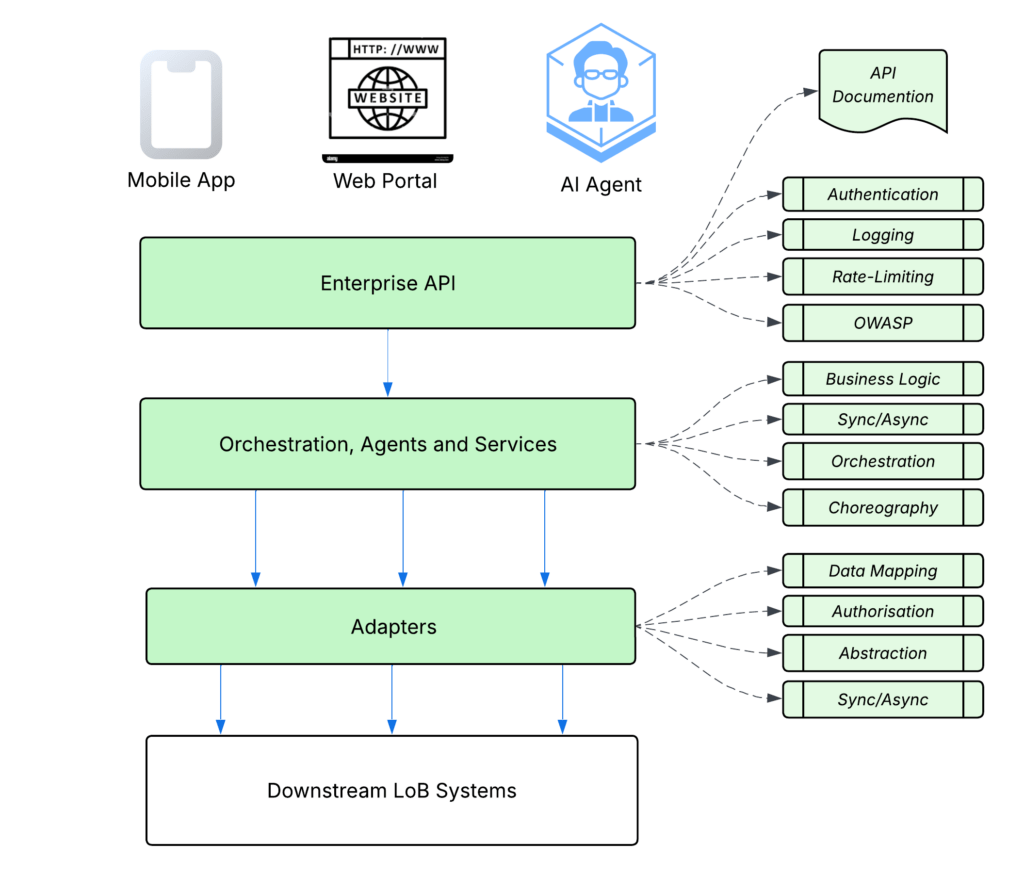
The ARRT Integration Brain provides a structured way to handle integrations end to end.
It allows external systems to trigger business processes, applies rules and logic, and connects into multiple line of business systems to complete those processes.
In practice, that means:
Business processes are exposed through APIs
Logic is handled centrally through orchestration
Connections to systems are managed through reusable adapters
Instead of building one off solutions each time, the same pattern can be reused and adapted.
This consistency removes much of the friction teams previously experienced day to day.
Adoption Across Teams
Getting to this point required a shift across multiple teams at Titan.
They told us some teams were used to “quick, drag and drop solutions” and initially saw the Brain as additional development effort. It required a change in mindset, as well as upskilling across squads.
As the approach was rolled out more widely, teams began to see the benefit of working from a consistent pattern rather than solving each integration from scratch.
They also highlighted that improvements in developer enablement and AI assisted code generation have removed the perceived speed trade off, while significantly improving scalability, maintainability and production readiness.
What once felt like additional effort is now part of the normal way of working. Building a scalable solution is now just as quick as building a tactical one.
Day to Day Impact
The impact is now visible in day to day delivery.
They told us teams are “reducing thinking time on solutions” and able to “move at pace” while avoiding the manual operational overhead that often comes with production systems.
From a leadership perspective, they also noted an improvement in decision quality. Teams now start from a secure, observable and well understood integration baseline, reducing design churn and long term technical debt.
Instead of revisiting the same problems, they are working from a known, reliable pattern.
A Different Starting Point
Perhaps the biggest change has been architectural.
They told us that rather than starting with a quick fix and adapting later, teams are now “starting the right way in our architecture”. This reduces technical debt and creates a foundation they can build on.
It has also changed delivery timelines.
What would previously have taken months to design and implement is now being delivered in a matter of weeks, without compromising on quality or scalability.
As they reflected:
“What would have previously been a 6 month project would likely have resulted in a tactical solution. Now we are delivering in a much shorter window with a solid foundation we can build upon.”
Conclusion
This is where the value really shows.
It is not just about delivering faster, although that is part of it. It is about reducing the need to solve the same problems repeatedly, lowering operational overhead, and creating a foundation that can scale.
For Titan, this has been particularly important as the organisation continues to grow and integrate additional systems.
As their Group CTO reflected:
“The Integration Brain enables us to deliver enterprise ready foundations at the speed the business demands, while avoiding the accumulation of operational risk and technical debt.”
The ARRT Integration Brain is not just a solution. It has become the standard way of working at Titan.
If you’re dealing with multiple integrations and trying to balance quick delivery with long term scalability, it might be time to step back and rethink the approach.
For teams unsure where to start, we typically begin with a short health check to assess current integrations, identify risks, and highlight opportunities to improve.
From there, a focused kickstart can help establish a scalable foundation and set the direction for future delivery.
We’re always happy to share how others are tackling this in practice.
If you are looking to strengthen resilience, modernise your integration estate or accelerate transformation work, we are always happy to share what we are seeing across the sector and what is working well in practice Contact Us

follow us